


Home / Blog / Industry News / OEM Reed Diffuser Manufacturing Guide: Custom Bottles, Fragrance, Reeds & Packaging
OEM Reed Diffuser Manufacturing Guide: Custom Bottles, Fragrance, Reeds & Packaging
Content
When a brand team comes to us with a reed diffuser concept, the first question is rarely about the scent. It is about how the product will be made: who compounds the fragrance oil, who supplies the bottle and the reeds, and who carries the risk when a liquid product has to ship across borders, sit on a shelf for months, and still open with the right scent intensity. The conclusion after years of OEM production is simple: a reed diffuser project is decided before the first bottle is filled. Get the specification right — fragrance load, reed material, bottle neck geometry, closure system, and packaging — and manufacturing becomes routine execution. Get any one of them wrong, and you will spend the rest of the project fixing leaks, weak scent throw, or inconsistent batches.
This guide covers the decisions that matter in OEM reed diffuser manufacturing, based on the production process we run at our factory in Suzhou.
An OEM reed diffuser is not a single item; it is a system of components that must be engineered to work together.
The manufacturer's responsibility usually goes beyond pouring liquid into glass. It includes selecting a compatible bottle, matching the fragrance to the carrier, testing how the reeds wick the finished blend, and designing packaging that survives freight. That is why a successful project starts with a specification conversation, not a purchase order.
The fragrance oil decides how the product smells, how long it lasts, and whether the product is legal to sell. Three variables matter most.
Fragrance load is the percentage of fragrance concentrate in the finished liquid. Most reed diffusers sit between 10 and 30 percent. At 10 percent, the scent reads as subtle, which works for budget retail lines. At 20 percent, the diffuser has a clear presence in a typical living room, and this is the most common starting point for premium private label products. At 30 percent, the intensity is strong enough for hotel lobbies and retail spaces where other odours compete for attention. A higher load costs more, but a weak load is the fastest way to lose a customer at first use.
The carrier base controls evaporation speed and wicking behaviour. A base with a high alcohol share releases scent quickly and produces an immediate impression, while a solvent-based or oil-based carrier evaporates more slowly and gives a longer, steadier release. Each type pairs with different reeds and different bottle-neck openings, so the base must be fixed before the rest of the system is designed. On the compliance side, every fragrance component should meet IFRA standards and the applicable EU or regional regulations. A reliable manufacturer will provide safety data sheets and compound documentation for the finished formulation.
Reeds are the only visible part of the system that changes while the product is in use, which makes their material a performance issue as much as a quality issue.
| Criteria | Natural rattan | Fiber reeds |
|---|---|---|
| Wicking rate | Moderate and batch-dependent | Consistent and faster |
| Best carrier type | Low-viscosity, alcohol-rich bases | Oil-based and thicker carriers |
| Appearance | Natural, organic texture | Uniform, available in colours |
| Performance life | Shorter, more prone to clogging | Longer and more stable |
Stick diameter is typically 2 to 4 mm, and length is matched to the bottle so that 10 to 15 cm extends above the neck. Most configurations use six to ten sticks depending on the bottle opening. The combination of bottle, liquid, and reed is tested together in our factory, because a reed that wicks perfectly in one base can saturate or clog in another.
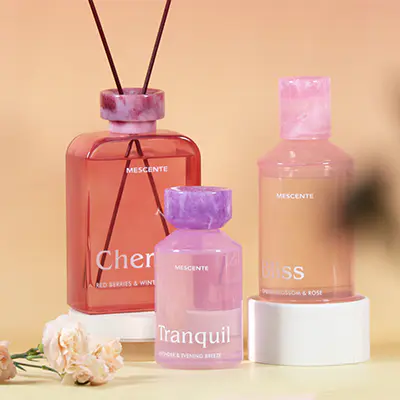
The bottle is the most visible part of the product and the area where customisation matters most. Frosted glass is the standard choice for private label reed diffusers because it hides sediment, photographs well, and feels premium in the hand. Clear glass shows the colour of the liquid, while amber or dark glass protects UV-sensitive fragrance oils. Ceramic bottles add weight and a noticeably more luxurious look, with far more freedom in shape and finish. For brands that want a distinctive vessel, our custom ceramic bottle reed diffuser combines the durability of ceramic with a silhouette that is unique to the client's range. The trade-offs with ceramic are higher unit cost and heavier freight, and a custom mould requires tooling and a longer lead time than a stock glass bottle.
The neck and closure system deserve as much attention as the bottle body. An orifice reducer — the plastic collar around the reeds — fixes how many sticks sit in the liquid and therefore controls the evaporation rate. The cap must seal tightly enough to survive shipping, and we pressure test filled bottles before they are packed. Every component in this chain has to be compatible; a beautiful bottle with the wrong neck finish will fail in production or in transit.
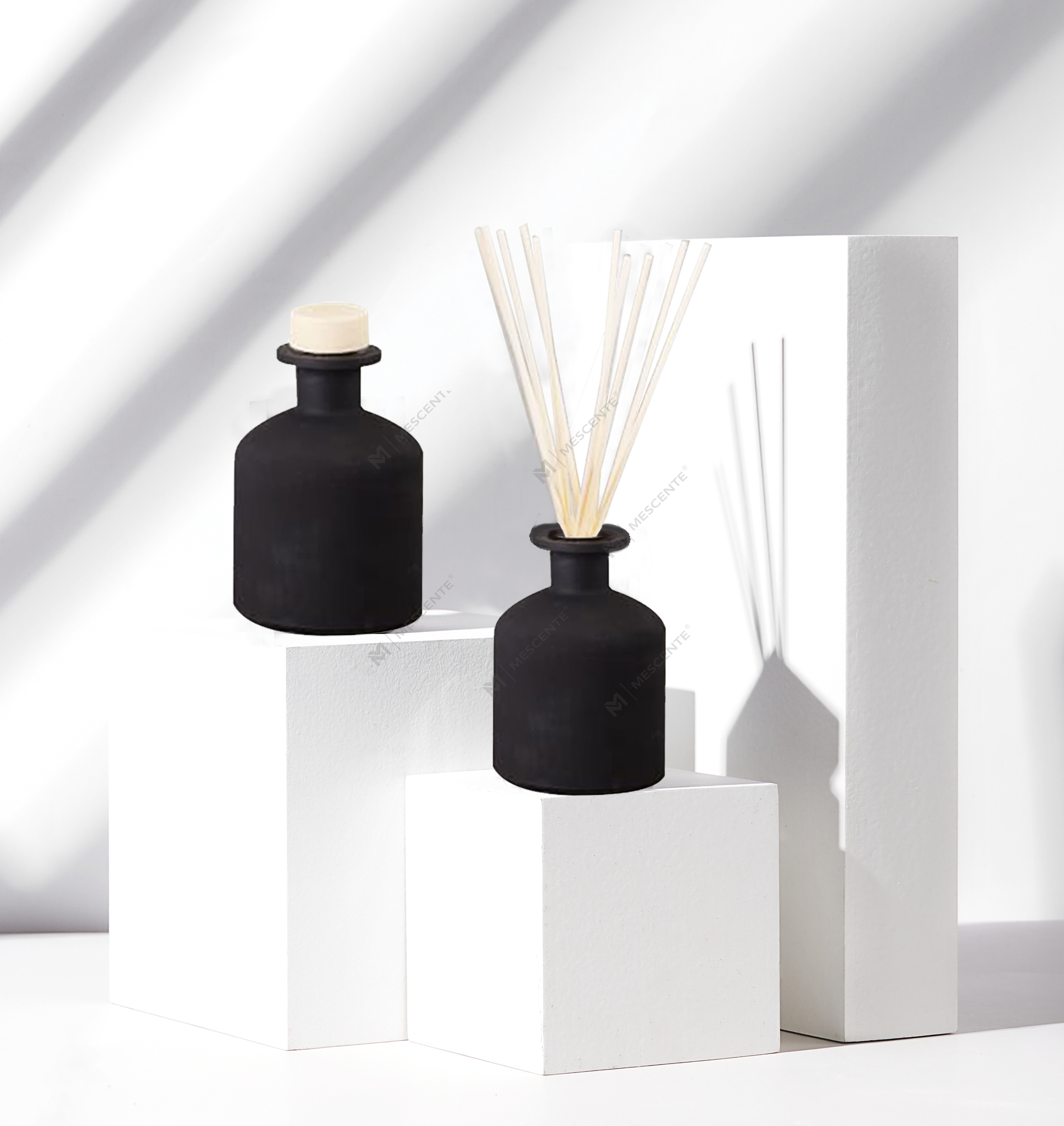
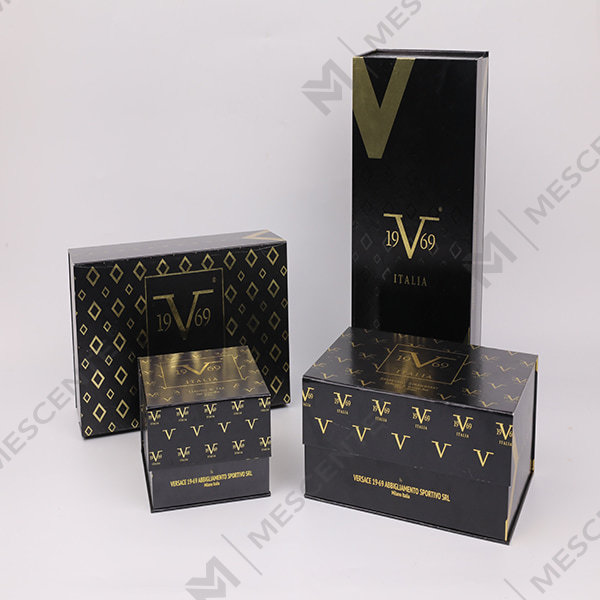
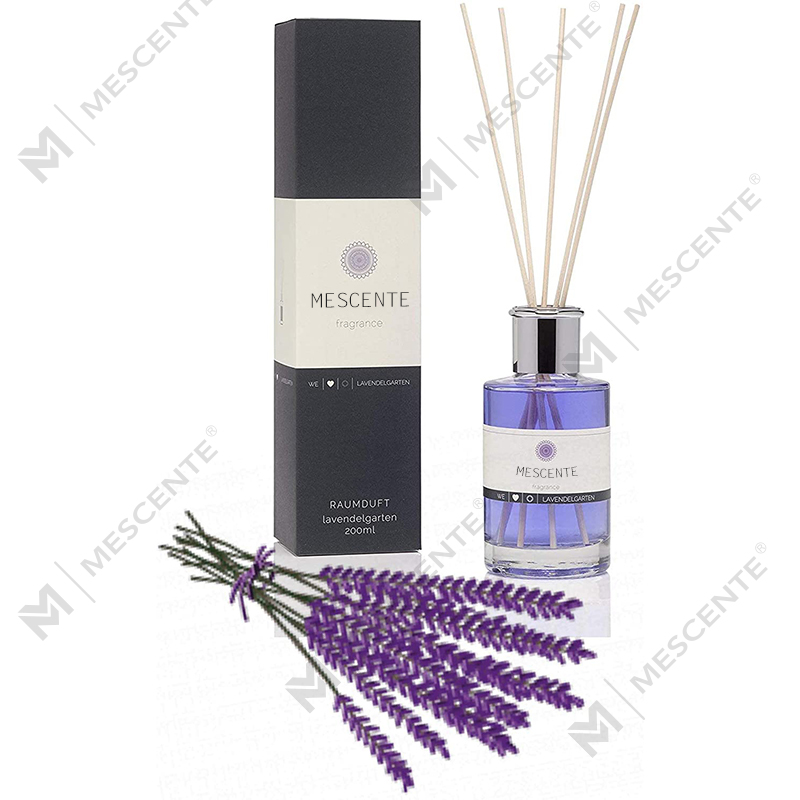
Most OEM reed diffuser projects are private label projects: the client's brand appears on the bottle, the carton, and ideally in the scent itself. Customisation typically covers the bottle finish, logo application through labelling or screen printing, label artwork, box construction, and fragrance selection from an existing library or a bespoke brief. A private label frosted bottle reed diffuser with a branded box is one of the fastest routes to market, because every component in the spec is already proven in bulk production.
 Custom Private Label White Frosted Bottle Aromatherapy Reed Diffuser Oils With BSuzhou M&scent Is China Custom Private Label White Frosted Bottle Aromatherapy Reed Diffuser Oils With Box A29148 ODM/OEM Suppliers, Comp...View Product →
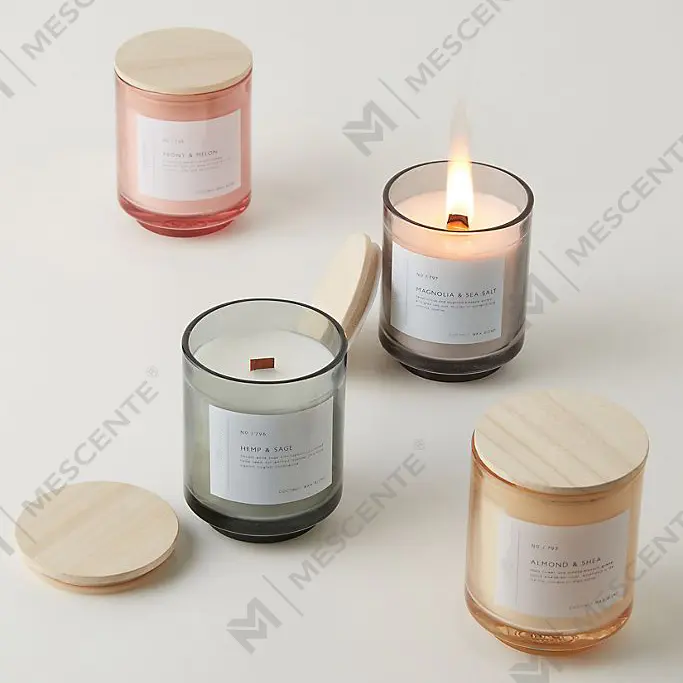
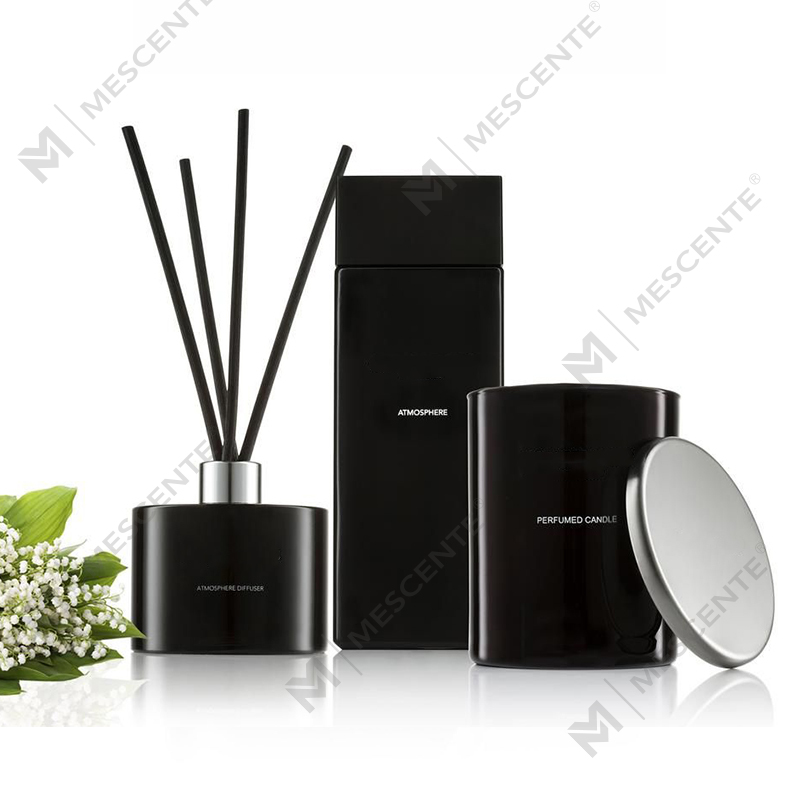
Gift sets are just as common in OEM orders. Combining a reed diffuser with a scented candle in a single box raises the perceived value of both products, and many clients start with a standalone diffuser and then expand into matching items from the same fragrance family. The reed diffuser and candle gift set range is a practical starting point for that kind of expansion.
A structured workflow catches problems while they are still inexpensive to fix.
Sampling usually takes one to two weeks when the fragrance library and stock bottles cover the requirement. A bespoke scent, a new bottle mould, or custom packaging extends that timeline, so it should be planned into the product launch calendar.
Reed diffusers fail in predictable ways, and a good QC plan is built around those failure modes.
One habit we recommend to every client is keeping their own retained sample from the pre-production approval stage. If a shipment ever raises a question about scent or colour, both sides can compare against the same reference.
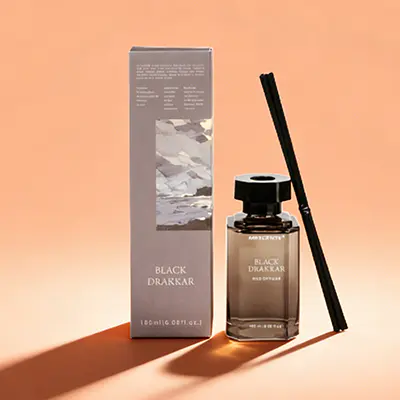
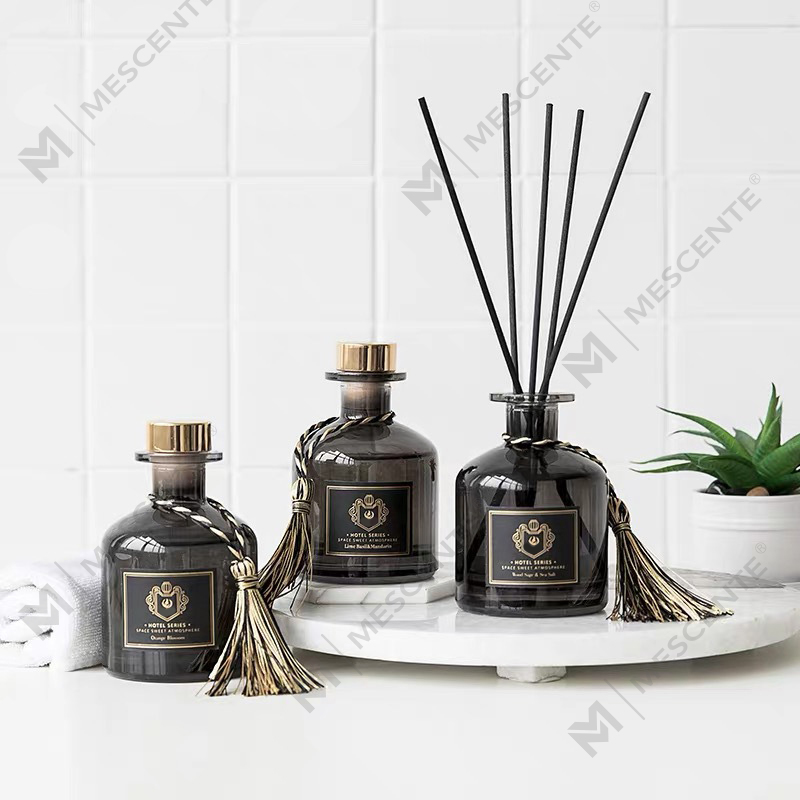
Hospitality projects need a different specification from retail. A hotel reed diffuser must perform for weeks with minimal attention, remain safe in guest rooms, and deliver consistent scent across hundreds of rooms. The practical format is usually a larger bottle with a higher fragrance load and fiber reeds, so the scent profile stays reliable in air-conditioned spaces. For this use, our 180ml hotel-grade glass bottle reed diffuser is the specification we recommend most often, with the property's logo and a scent selected from our hotel fragrance library. Buyers who want to understand the performance side before specifying can read our notes on hotel reed diffuser scent throw and longevity, which covers the same trade-offs in more detail.
 Custom Mescente Luxury 180ml Customised Glass Bottle Essential Oil Reed DiffuserSuzhou M&scent Is China Custom Mescente Luxury 180ml Customised Glass Bottle Essential Oil Reed Diffuser For Hotels ODM/OEM Suppliers, Co...View Product →
The right manufacturer converts your specification into a product with predictable cost, lead time, and quality. Evaluate four things: the breadth of the product line, because a wider range means more proven bottle and reed combinations; in-house capabilities in fragrance, printing, and assembly; the quality of pre-production samples; and the factory's willingness to test the complete system instead of simply filling a bottle.
At M-Scent in Suzhou, reed diffuser production sits inside a wider home fragrance system that includes scented candles, room sprays, aroma stones, and gift sets. That structure matters for OEM buyers, because a brand can launch a reed diffuser and later expand into matching products without changing manufacturers. The reed diffuser product range covers glass and ceramic bottles, rattan and fiber reeds, and wholesale, custom, and private label formats. If you are evaluating a sourcing partner for a new line, the most useful next step is to request samples against your own specification — that single exercise reveals more about a manufacturer's reliability than any catalogue.
-1.jpg "140g Home Scented Candle Fragrance Reed Diffuser Gift Set A99199")
-2.jpg "M&Scent Luxury Custom Private Label Glass Bottle Flower Liquid Reed Diffuser With Gift Box")
.jpg "M&Scent Black Bottle Perfume Aroma Reed Diffuser Oil, Fragrance Thailand Reed Diffusers Gift Set")

Address:
Building 10, No. 39, Muxu East Road, Mudu Town, Wuzhong District, Suzhou City, Jiangsu Province, China
Company
Products
Mobile
