


Home / Blog / Industry News / How Reed Diffuser Fragrance Oil Is Formulated: Carrier, Ratios & IFRA Rules
How Reed Diffuser Fragrance Oil Is Formulated: Carrier, Ratios & IFRA Rules
Content
A reed diffuser rarely fails because of the reeds or the glass bottle. It fails because of the oil. When a batch comes off the line with a weak scent, reeds that barely wick, or a shelf life of two weeks instead of eight, the cause can almost always be traced to the formulation: the carrier system, the fragrance load, and how the two are balanced. Get those right and the product sells itself; get them wrong and no packaging will save it.
This guide explains how reed diffuser fragrance oil is formulated from a manufacturer's point of view: what actually goes into the bottle, why each ingredient is there, and what buyers should check before approving a formula for their own brand.
Reed diffuser oil is not pure fragrance. In a typical commercial formula, only 15–30% of the liquid is fragrance concentrate. The rest is the carrier: a solvent system that keeps the fragrance dissolved, gives the oil the right viscosity to climb the reeds, and controls how quickly the scent evaporates into the room.
The dominant carrier in the industry is dipropylene glycol (DPG). DPG is a near-odourless, low-volatility solvent with strong dissolving power for fragrance raw materials. It is also the reason a bottle can keep releasing scent for six to eight weeks: DPG releases the fragrance gradually rather than letting it flash off.
A formulator usually blends DPG with a second or third solvent to fine-tune performance. A typical starting composition looks like this:
| Component | Typical share | Role in the finished oil |
|---|---|---|
| DPG (dipropylene glycol) | 60–85% | Primary solvent; steady evaporation; keeps fragrance solubilised |
| Isopropyl myristate (IPM) | 5–15% | Low-viscosity thinner; improves capillary rise in the reeds |
| Ethanol or SDA alcohol | 0–10% | Boosts initial scent throw; dries faster on the reed surface |
| Additives and stabilisers | 0–3% | Antioxidants, colour and odour adjusters |
Why does this matter? Because the carrier controls the two performance indicators that consumers feel every day: wicking and longevity. Too much DPG makes the oil heavy; reeds pull it up slowly and the scent stays trapped in the bottle. Too much alcohol makes the oil thin and quick; the first week smells strong, then the bottle runs dry or the scent flattens. The craft of formulation is finding the blend that stays between those extremes.
Once the carrier is set, the decisive question is how much fragrance concentrate to dissolve into it. This number, the fragrance load, is the single most important specification on a reed diffuser datasheet.
In commercial production, a fragrance load of 20–30% is standard for reed diffusers that need a clear scent presence. A 30% load offers the best scent throw and the longest usable life, which is why it is the default for hotels and for brands that want a strong signature scent. A 15–20% load works for lighter, cost-sensitive programmes, and anything below 10–12% will generally disappoint: the top notes disappear within the first week and the remaining scent is too weak to register across a normal-sized room. The formulation behind our 180ml customised glass bottle reed diffuser for hotels is built on this principle.
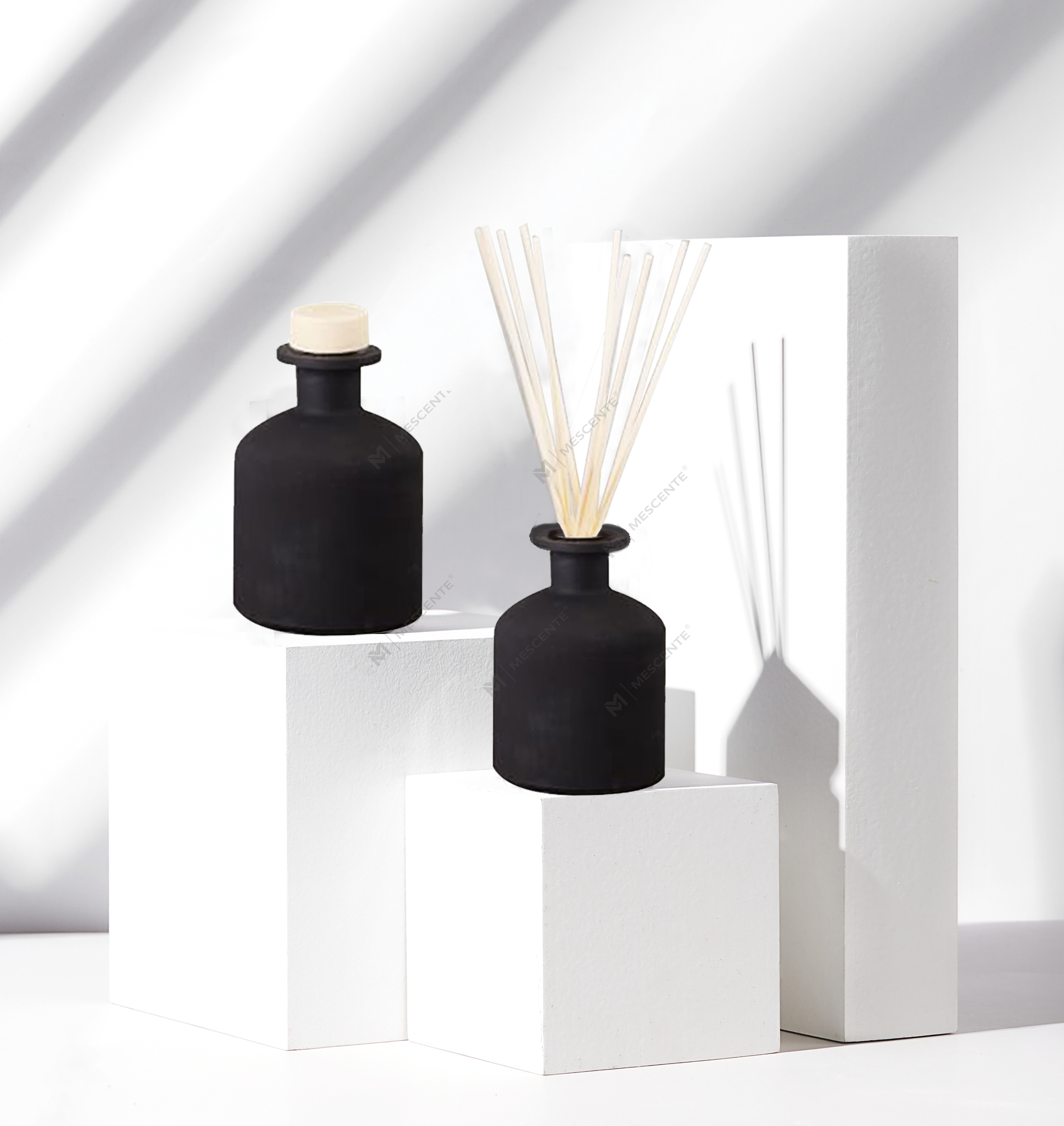 Custom Mescente Luxury 180ml Customised Glass Bottle Essential Oil Reed DiffuserSuzhou M&scent Is China Custom Mescente Luxury 180ml Customised Glass Bottle Essential Oil Reed Diffuser For Hotels ODM/OEM Suppliers, Co...View Product →
The load does not only change strength; it changes the scent pyramid. Fragrance oils are built from top, middle and base notes. A low load erases the top notes first, because the carrier dilutes them beyond perception. That is why two diffusers with the same fragrance can smell completely different by week three: the richer one still delivers middle and base notes, while the lean one has nothing left.
For buyers, the load is also a cost lever. Fragrance concentrate is the most expensive ingredient in the bottle. A 30% load can raise unit cost by 15–25% compared with a 20% load, depending on the fragrance type. Cutting the load saves money on paper and costs customers in reality, which is why a high-fragrance formula is the foundation of long-lasting scent throw in hotel use.
The other raw-material decision is the type of fragrance itself. Essential oils are attractive in marketing, but they are rarely used as the entire fragrance component in a reed diffuser. Many essential oils are too volatile to persist for weeks, and some are restricted by IFRA for non-skin-contact room fragrance use. Most commercial formulas therefore use a fragrance oil: a concentrate built from synthetic aroma chemicals and selected naturals. A well-built fragrance oil delivers three things essential oils struggle to provide alone: tenacity across six to eight weeks, full solubility in the carrier, and consistent batch-to-batch scent.
After the load comes refinement. A formula can look fine and still fail in production, and the three usual culprits are insolubility, oxidation and viscosity.
Most fragrance raw materials are soluble in DPG, but a few heavy naturals and musks can separate or crystallise when the temperature drops. A careful formulator runs a hold test: the finished oil is kept at 4°C and at 40°C, then checked for haze, crystals and separation. If anything precipitates, a co-solvent such as benzyl benzoate is added in small increments.
Oxidation matters for citrus and pine-heavy formulas. The terpenes in these scents react with oxygen over weeks, yellowing the oil and producing an off note. Antioxidants, often tocopherol (vitamin E) or BHT at 0.05–0.1%, slow this process and keep the scent clean.
Viscosity completes the trio. Reed diffuser oil is formulated to be thin enough to climb a reed, yet thick enough not to drip from the reed tips. This is also where the environment bites: a formula designed for a warm warehouse behaves differently in a cold store, so brands that ship internationally need a blend that stays consistent across temperatures. We look at this challenge in more detail in our discussion of the environmental stability of reed diffusers.
No reed diffuser oil can be judged without reeds. The product works by capillary action: the oil rises through the porous stick and evaporates from the exposed surface. That behaviour is set by the oil's surface tension and viscosity, and by the reed's pore structure.
Rattan reeds are the classic choice, offering a relaxed, subtle release that suits bedrooms and powder rooms. Fiber reeds wick faster and deliver a stronger initial throw, which is why they dominate retail products where customers expect scent within the first hour.
The formulation advice is direct: do not choose the bottle and the reed first, then ask the oil supplier to make it fit. The carrier, the load and the reed must be developed together. If a brand wants the fast performance of fiber sticks, for example, we blend the oil slightly more viscous so it does not blow through the reed too quickly. A luxury private-label fiber-stick reed diffuser is a good example of this tuned pairing.
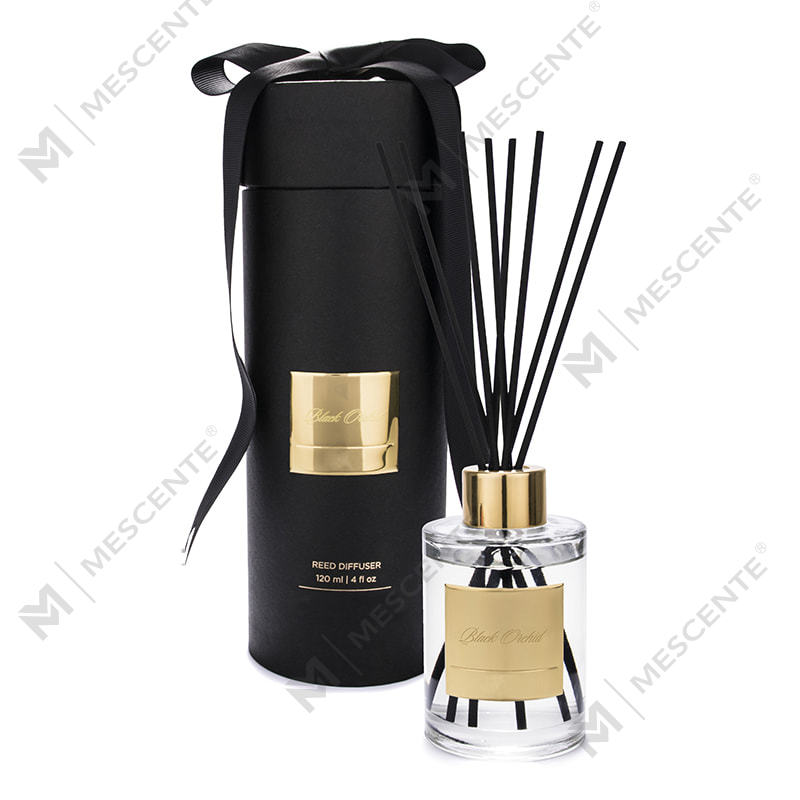 Custom M&Scent Luxury Private Label Home Fragrance Fiber Stick Reed Diffuser A29Suzhou M&scent Is China Custom M&Scent Luxury Private Label Home Fragrance Fiber Stick Reed Diffuser A29261-1 ODM/OEM Suppliers, Company,...View Product →
Reeds also change how the scent is perceived. An oil that performs well in a beaker can smell muted when moved to a slow-wicking rattan reed. Formulators therefore test the complete system — oil, reeds, bottle and room volume — before approving a commercial run. If you are developing your own recipe, data on wicking efficiency of essential-oil blends is a useful starting point.
Formulation is not only chemistry; it is regulation. Fragrance concentrates sold into the EU and a growing number of other markets must be IFRA-compliant, meaning the concentrate's maximum usage level for the intended product category is assessed by a qualified safety assessor.
For reed diffuser oil, the audit trail a buyer should expect includes:
Ask for these documents before approving samples, not after placing the order. A supplier that cannot show an IFRA certificate for the concentrate is risking your brand. Allergen labelling is a legal requirement in the EU and must be printed accurately on the outer pack.
A formula that works in a one-litre beaker can fail in a two-hundred-litre mixing tank if the process is wrong. Professional reed diffuser production follows a defined sequence: the carrier is weighed into the tank, the fragrance is added slowly under agitation, additives go in, and the batch is mixed for a set time at controlled temperature before being held for quality control.
The quality control check should measure, at a minimum, specific gravity, appearance, fragrance character, viscosity and stability at low and high temperature. For hotel and private label programmes, batch-to-batch consistency is as important as the formula itself, because a hotel corridor or a retail shelf will expose any deviation.
For brands that want to sell under their own name, the same formulation discipline applies to the private label route: the oil is blended to a set specification, the bottle is customised, and the label and packaging match your design. A private label white frosted bottle reed diffuser is a common starting point for this kind of programme.
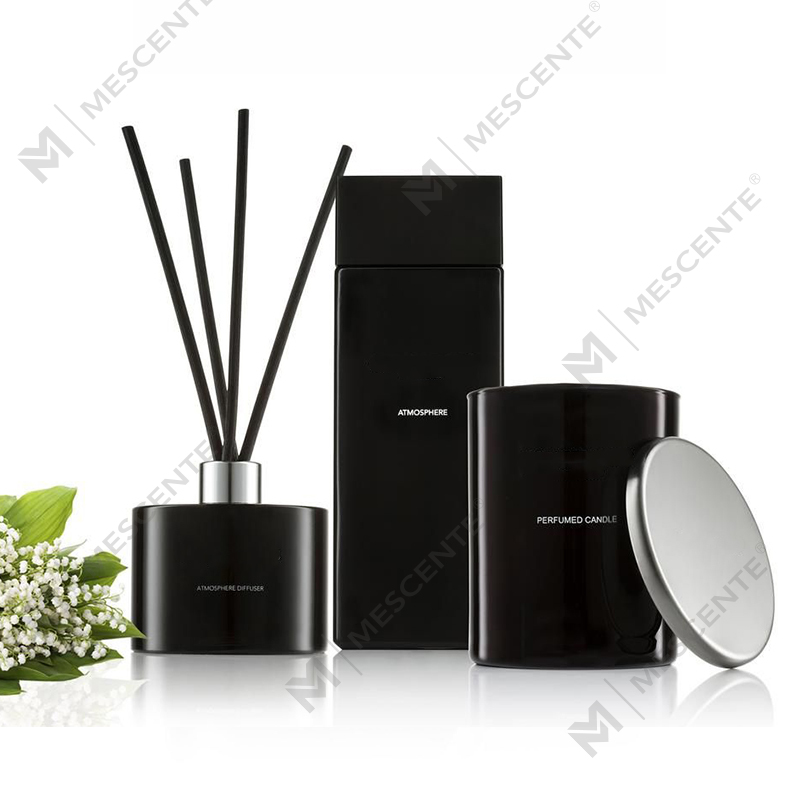 Custom Private Label White Frosted Bottle Aromatherapy Reed Diffuser Oils With BSuzhou M&scent Is China Custom Private Label White Frosted Bottle Aromatherapy Reed Diffuser Oils With Box A29148 ODM/OEM Suppliers, Comp...View Product →
A well-formulated reed diffuser oil looks unremarkable: a clear, slightly viscous liquid in a plain bottle. Behind that liquid sit deliberate choices — a carrier that releases scent steadily, a fragrance load strong enough to survive eight weeks, and a compliance file that protects the brand across borders. Buyers who understand these choices stop buying oil by price per litre and start buying it by performance per week, which is the only metric that matters.
.jpg "M&Scent Black Bottle Perfume Aroma Reed Diffuser Oil, Fragrance Thailand Reed Diffusers Gift Set")
.jpg "Mini White Bottle Flower Perfume Aroma Reed Diffuser Oil, Fragrance Thailand Reed Diffuser Gift Set")
.jpg "White Flower Mini Perfume Aroma Reed Diffuser Oil, fragrance Thailand Reed Diffusers Gift Set")

Address:
Building 10, No. 39, Muxu East Road, Mudu Town, Wuzhong District, Suzhou City, Jiangsu Province, China
Company
Products
Mobile
