


Home / Blog / Industry News / Custom Reed Diffuser Solutions for Fragrance Brands: A Manufacturer's Guide
Custom Reed Diffuser Solutions for Fragrance Brands: A Manufacturer's Guide
Content
Bottles, oil, reeds and packaging: most reed diffuser projects fail because these four elements are specified separately instead of as one system. The scent is too faint by week six, the vessel pushes the unit cost past the retail plan, or the label series cannot scale. This guide explains what custom reed diffuser solutions for fragrance brands actually cover and how to brief a manufacturer correctly the first time.
Custom reed diffuser solutions are end-to-end manufacturing programs in which a factory adapts the fragrance oil, reed material, vessel, closure, labeling and packaging to a specific brand brief instead of delivering a stock item from a catalogue.
Buyers who understand the system get better pricing and faster timelines. Buyers who only ask for a diffuser with their label on it inherit whatever the supplier has in stock. The difference shows in three places: performance, packaging and the paperwork required for retail shelf compliance.
Fragrance oil is the largest factor in a reed diffuser's commercial survival, because every other component exists only to carry, release and present that formula consistently.
The carrier normally makes up 70-92 percent of the fill. MCT oil, dipropylene glycol (DPG) and ethanol blends are the most common bases, and each changes how fast the oil climbs the reeds and evaporates. The fragrance load usually sits between 8 and 30 percent. A low load keeps cost down but produces weak throw; a high load without proper carrier selection can saturate the reeds and shorten the diffuser's usable life.
Certification matters long before the first production order. Retailers in the European Union and North America expect IFRA declarations, allergen documentation and material safety data sheets. A custom reed diffuser solution should include these documents as part of the development package, not as an afterthought.
| Carrier base | MCT oil, DPG or ethanol blends | 70-92 percent of total fill | Controls evaporation speed and wick uptake |
| Fragrance load | 8-30 percent of total fill | Sets scent throw strength and perceived richness | Balanced against carrier for stable release |
| Scent longevity | 4-12 weeks of continuous use | Depends on load, carrier and reed material together | Tested in the final vessel before approval |
| Compliance documents | IFRA, MSDS, allergen list | Required for EU and North American retail | Confirmed in writing before sampling |
Reed material controls how quickly oil travels up the stick, how evenly scent is released into the room and how many weeks the bottle keeps performing.
Natural rattan reeds are the default for stock diffusers: inexpensive, renewable and attractive, but porous and irregular, so throw fades faster. High-density fiber reeds wick more consistently and last noticeably longer, which is why most premium private label programs specify them. Wood sticks deliver a different aesthetic and a slower release, yet need more testing because porosity varies between batches.
Typical continuous scent lifespan by reed material
Chart data reflects typical field performance of 8-12 reed configurations at a 15-20 percent fragrance load.
Stick count works with the neck opening. A narrow 18mm neck usually carries 6-9 reeds; a wide opening can take 15-20, which increases throw but also increases evaporation. Manufacturers tune reed count and oil viscosity together, and reed wicking efficiency documentation shows how oil-to-reed ratios change release rates in practice.
The bottle is the first physical proof of your brand, and it is also the component that most heavily determines unit cost and minimum order quantity.
Standard glass options include clear, amber, frosted, matte black and colored bottles from 100ml to 500ml. Semi-custom work starts with a stock vessel and changes the finish, cap and label. Fully custom vessels add a mold fee but give exclusive shapes that no competitor can copy. Ceramic raises both perceived value and unit cost, and works best when the diffuser is designed as a permanent decor object rather than a disposable refill.
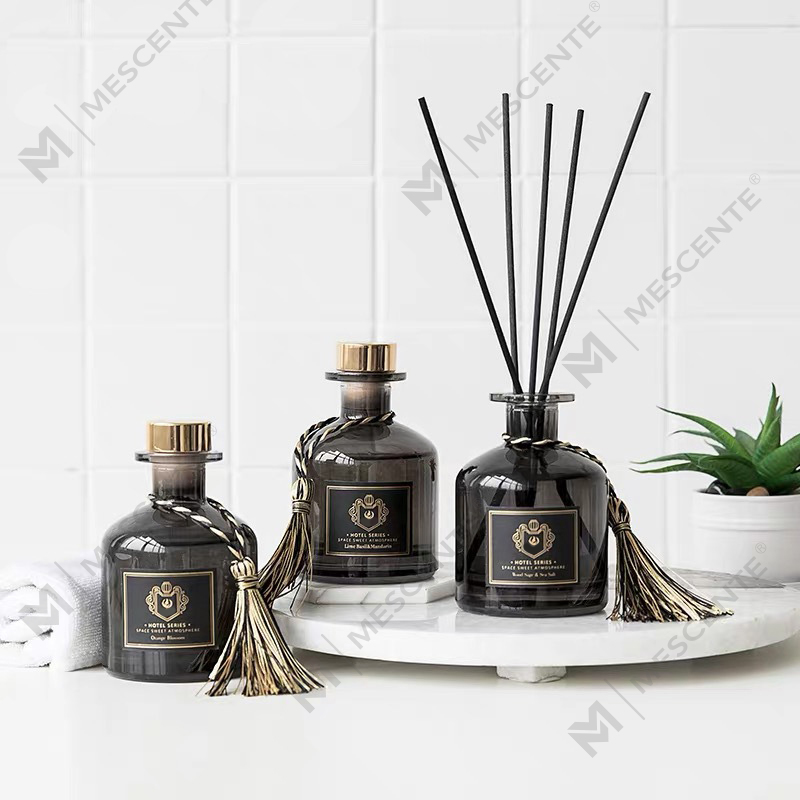
Hospitality buyers typically lock one scent, one bottle and one label series and reorder in large volumes, so a 180ml unit with fiber reeds has become a common specification. Suzhou M-Scent Arts & Crafts Co., Ltd. builds the custom 180ml glass bottle reed diffuser for hotels around exactly this format. Design-led brands usually move to ceramic, where a custom ceramic bottle reed diffuser changes the tactile story of the product completely.
 Custom Mescente Luxury 180ml Customised Glass Bottle Essential Oil Reed DiffuserSuzhou M&scent Is China Custom Mescente Luxury 180ml Customised Glass Bottle Essential Oil Reed Diffuser For Hotels ODM/OEM Suppliers, Co...View Product →
Hotel buyers rarely reorder a diffuser that loses throw in week four; scent throw longevity for hotel use explains the test methods that prevent this failure in long-run programs.
A private label reed diffuser earns its retail price in the unboxing, so packaging consistency and realistic minimum order quantities matter as much as the scent.
Label options fall into three groups: wet-glue paper labels for low cost and easy changeover, screen printing for durable bolder graphics, and hot-foil stamping for premium presentation. Gift boxes, inner trays and shrink wrapping are usually quoted separately from the bottle, and the difference shows up fast on large orders.
Realistic quantities: semi-custom programs on stock bottles generally start at 1000 units. Fully custom vessels, exclusive fragrances and bespoke packaging typically require 3000 units or more. Manufacturers quote these thresholds differently, so confirm them before sampling.
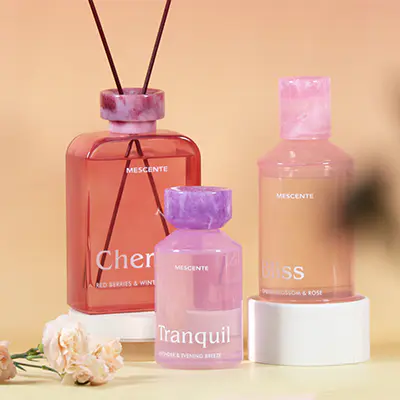
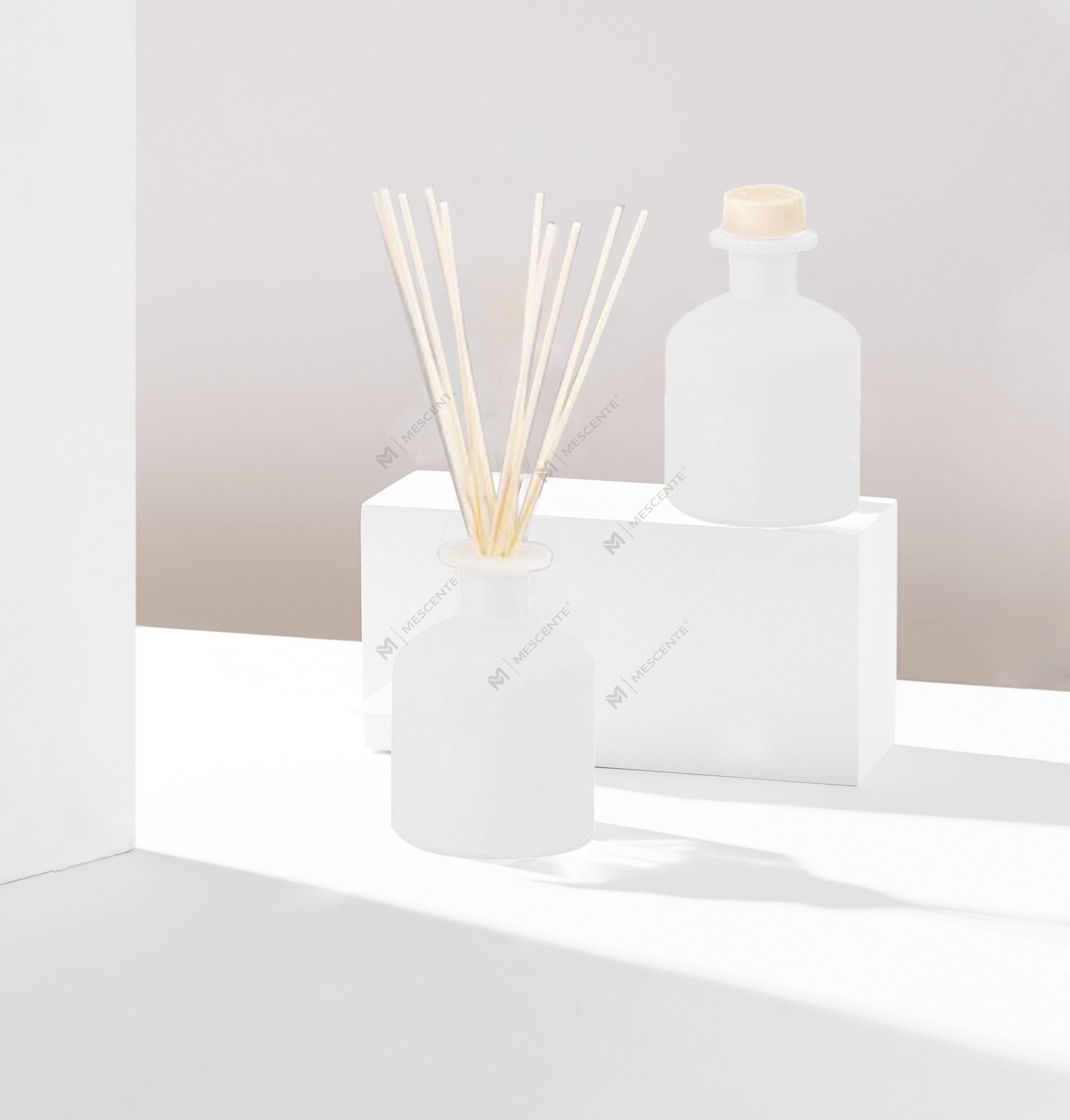
Frosted glass with a fitted box is the most common starting point for new brands because it reads premium at a moderate cost; a private label frosted bottle reed diffuser with box is the fastest route from concept to shelf.
 Custom Private Label White Frosted Bottle Aromatherapy Reed Diffuser Oils With BSuzhou M&scent Is China Custom Private Label White Frosted Bottle Aromatherapy Reed Diffuser Oils With Box A29148 ODM/OEM Suppliers, Comp...View Product →
Channel matters too. A boutique brand can sell a stronger, more decorative scent, while hotel programs usually need something neutral that does not interfere with meals or cleaning products. Hotel versus home scent profiles shows why those two briefs should never share one formula.
A realistic custom reed diffuser program takes six to ten weeks from the first brief to warehouse-ready stock, assuming a stock vessel and one round of sample revisions.
The buyer sends target scent, bottle concept, volume and target price. The supplier returns a cost sheet with MOQ and lead time within 3-5 working days.
The factory pours oil trials and orders the vessel; first functional samples arrive in 7-15 days.
The brand tests scent throw, wicking and packaging. One revision round is normal and takes 5-10 days.
Materials are ordered and quality control parameters confirmed; this stage runs 10-15 days.
Bottling, labeling and packing take 15-30 days depending on order size and packaging complexity.
Air freight adds 3-7 days, sea freight 2-5 weeks; packing lists, certificates of analysis and commercial documents are prepared at this stage.
Semi-custom programs on stock glass bottles and standard caps generally start at 1000 units. Fully custom vessels, exclusive fragrance formulations and bespoke packaging take minimums up to 3000 units or more. Ask for the MOQ per vessel and per scent, because some factories apply separate minimums.
Six to ten weeks is a realistic window: 7-15 days for the first sample, 5-10 days for revisions and approval, then 15-30 days of production. Shipping adds 3-7 days by air or 2-5 weeks by sea. Urgent programs can compress the timeline only if the vessel is a stock item.
High-density fiber reeds are the safest choice for consistent scent throw over eight to twelve weeks. Natural rattan gives an organic look but releases less evenly. Wood sticks work for short-run aesthetic products but require more testing because porosity varies between batches.
Usually yes, with limits. Gas chromatography-mass spectrometry (GC-MS) analysis identifies the main components of a target scent, and a perfumer rebuilds the formula. An exact duplicate is rarely guaranteed, so plan for two or three development rounds and a signature variation rather than a perfect clone.
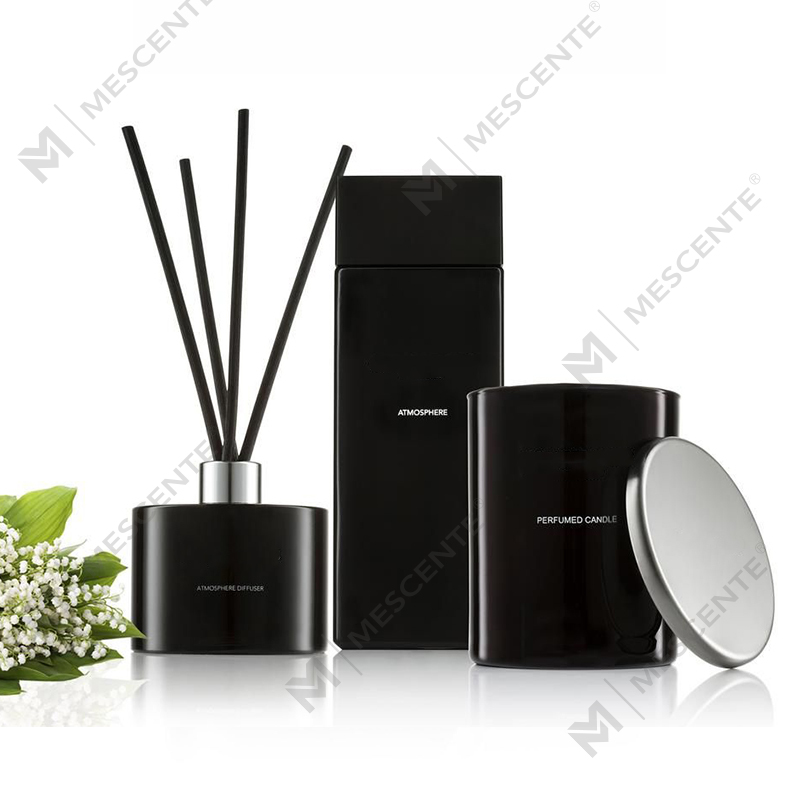
.jpg "150ml Home Fragrance Reed Diffuser Gift Set With Scented Candle A99189")

Address:
Building 10, No. 39, Muxu East Road, Mudu Town, Wuzhong District, Suzhou City, Jiangsu Province, China
Company
Products
Mobile
