


Home / Blog / Industry News / What Makes Scent Reed Diffusers a Popular Choice for Long-Lasting Home Fragrance?
What Makes Scent Reed Diffusers a Popular Choice for Long-Lasting Home Fragrance?
Content
Home fragrance has moved from an occasional indulgence to a daily routine for many households, and scent reed diffusers sit at the center of that shift. Unlike candles or electric devices, a reed diffuser relies on nothing more than porous sticks, a glass vessel, and a carefully balanced fragrance oil to keep a room smelling consistent for weeks at a time. This guide looks at how reed diffuser systems work, what makes them a preferred home fragrance product, and how the right materials and manufacturing choices shape performance across residential, hospitality, and commercial spaces.
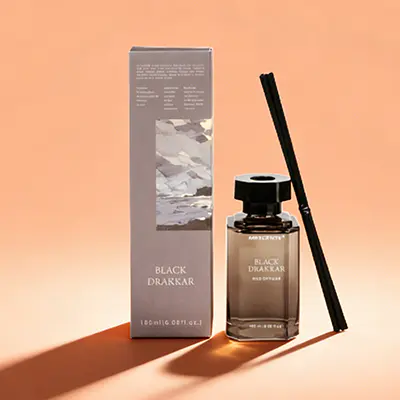
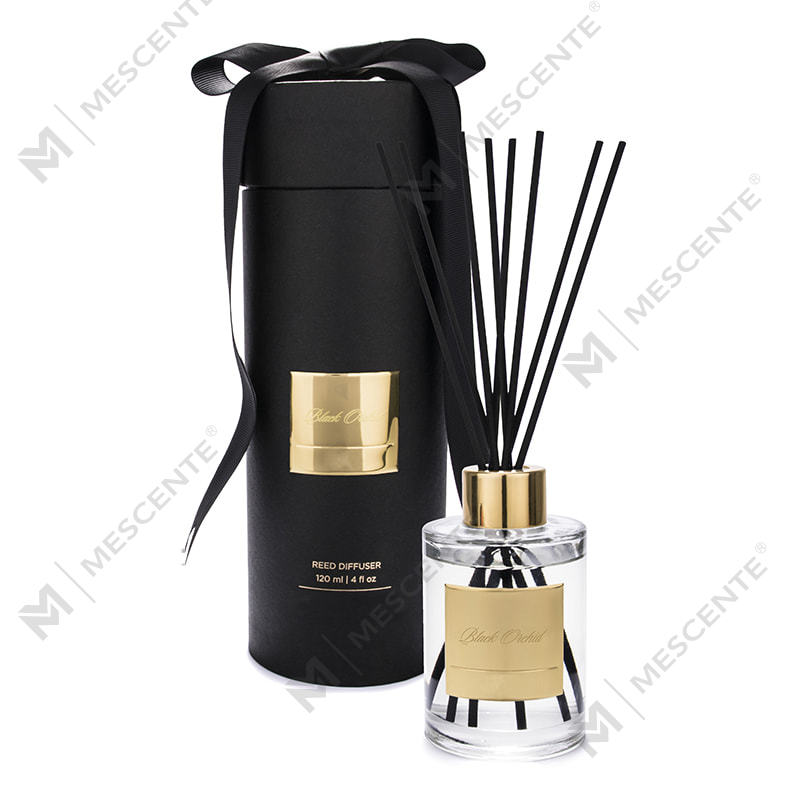
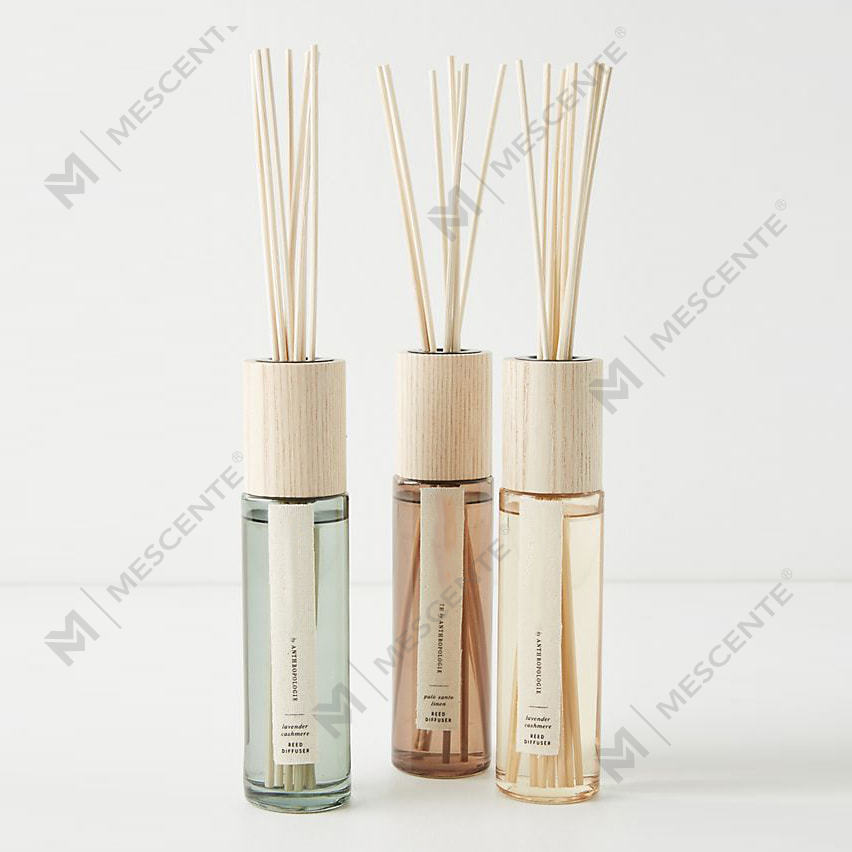
A reed diffuser system is a passive fragrance solution built around three parts: a bottle of scented oil, a set of absorbent reed sticks, and a neck opening sized to control evaporation. Once the reeds are inserted, capillary action draws the fragrance oil upward through the fibrous channels inside each stick. As the oil reaches the exposed surface at the top, it evaporates into the surrounding air, releasing fragrance continuously without any external power source.
Every reed diffuser system depends on the interaction between the bottle, the oil, and the reeds themselves. The bottle geometry, particularly the width of the neck, regulates how much surface area is exposed to open air, which in turn affects how quickly the fragrance disperses. A narrower neck slows evaporation for a longer-lasting, subtler scent, while a wider opening produces a stronger throw suited to larger rooms.
Reed sticks are manufactured with internal channels that pull liquid upward through capillary action, the same mechanism that draws water up a paper towel. As oil reaches the top of each reed, it evaporates gradually into the room. Flipping the reeds periodically refreshes the exposed surface and helps maintain a steady fragrance diffuser output over the life of the bottle.
Where candles rely on heat to melt wax and vaporize fragrance, and plug-in devices depend on an electrical heating element or fan, a home scent diffuser using reeds operates entirely through passive evaporation. This removes the need for supervision, power outlets, or open flame, making it suitable for spaces where those requirements are impractical.
Several design characteristics explain why reed diffuser advantages continue to resonate with households and commercial spaces alike.
Because evaporation happens gradually and consistently, room fragrance intensity stays even over time rather than spiking and fading the way a burning candle does.
With no wick to light and no cord to plug in, a long lasting scent diffuser can be placed on shelves, entryway tables, or bathroom counters without safety monitoring.
Glass bottles and coordinated reed colors double as a visual accessory, allowing the diffuser to complement shelving, console tables, or bathroom vanities.
Oil concentration and reed count can be adjusted to suit a small powder room or an open-plan living area, giving each space an appropriately scaled scent profile.
Reed diffuser applications extend well beyond the living room, with format and fragrance strength typically adjusted to match the setting.
Softer fragrance oils are common in bedrooms, while entryways and living rooms often use a stronger throw to greet guests upon arrival.
Lobbies and guest rooms rely on hospitality scent products to create a consistent olfactory signature that guests associate with the property.
Office fragrance products are typically kept subtle, favoring clean or neutral notes that do not interfere with shared workspaces.
Ambient scent products in retail settings are chosen to reinforce a store's identity and shape how customers experience the physical space.
The fragrance oil for reed diffuser use is formulated to balance viscosity with evaporation rate, ensuring the scent formulation travels evenly through the reed fibers instead of pooling or drying out too quickly.
Diffuser reeds are generally made from rattan or fiber-based reed sticks, chosen for consistent internal channels that support even fragrance absorption over the life of the bottle.
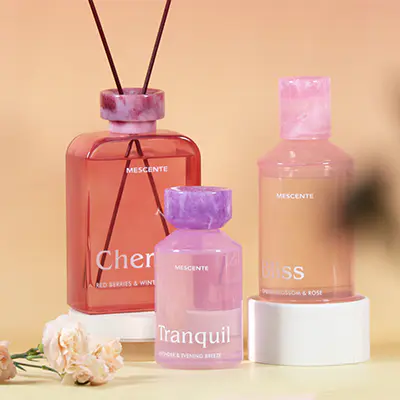
Glass diffuser containers are favored for their resistance to oil absorption and their compatibility with fragrance packaging design that supports both function and shelf appeal.
Formulators balance oil concentration, carrier ratios, and scent notes to achieve a stable, evenly diffusing blend.
Bottles are filled to a controlled volume, and reeds are inserted at a set count to match the intended diffusion strength.
Sample batches are checked for absorption consistency, evaporation rate, and oil stability before packaging.
Finished units are packaged with attention to bottle presentation, labeling, and any market-specific customization requirements.
Passive evaporation, no flame or power needed, consistent output over several weeks, low maintenance beyond flipping reeds.
Requires an open flame and active supervision, fragrance intensity varies with burn time, shorter overall lifespan per unit.
| Aspect | Reed Diffuser | Electric Aroma Diffuser |
| Power source | None required | Electricity needed |
| Maintenance | Occasional reed flipping | Refilling and cleaning components |
| Fragrance consistency | Steady and gradual | Can vary with settings and airflow |
Interest in natural and sustainable fragrance solutions is shaping new oil formulations and packaging choices. At the same time, more customized fragrance experiences are becoming available, along with a broader use of decorative and functional home fragrance products that double as interior accessories rather than purely functional items.
From residential interiors to hotel lobbies and retail floors, reed diffuser solutions continue to offer a dependable balance of simplicity, longevity, and design flexibility. Their passive mechanism removes the need for flame or electricity while still delivering steady, long lasting fragrance systems suited to a wide range of spaces. For anyone comparing interior scent solutions, scent reed diffusers remain a practical starting point built on straightforward materials and a well-understood diffusion process.
.jpg "150ml Home Fragrance Reed Diffuser Gift Set With Scented Candle A99189")
-1.jpg "140g Home Scented Candle Fragrance Reed Diffuser Gift Set A99199")

Address:
Building 10, No. 39, Muxu East Road, Mudu Town, Wuzhong District, Suzhou City, Jiangsu Province, China
Company
Products
Mobile
