A room can feel finished or unfinished based on how it smells, which is why so many households now keep a home fragrance diffuser running quietly in the background. Unlike a quick burst of air freshener, a diffuser builds a steady, low-level scent presence that lasts for hours. This guide walks through how diffusers work, the main types available, and how to pick the right one for a given room.
What Is a Home Fragrance Diffuser and How Does It Work in Scent Distribution?
A home fragrance diffuser definition is straightforward: a device or object designed to release scent into a room gradually and consistently, rather than in a single quick spray. It is part of a broader aroma diffusion system that includes everything from simple reed sticks to powered electronic units.
An essential oil diffuser device typically uses one of a few indoor scent dispersal methods — evaporation, ultrasonic vibration, or fine misting — to move fragrance molecules into the air. As part of an air freshening fragrance system, the goal is even coverage over time instead of one strong initial burst that fades quickly.
What a home fragrance diffuser is used for varies by household, but the underlying job stays consistent: maintaining a pleasant, low-intensity scent rather than masking odor with a single strong spray. How fragrance diffusers spread scent in a room depends on airflow and placement as much as the device itself. The difference between a diffuser and an air freshener spray comes down to duration — one releases scent continuously over hours or weeks, the other all at once.
What Are the Main Types of Home Fragrance Diffusers?
| Type |
How It Releases Scent |
Best For |
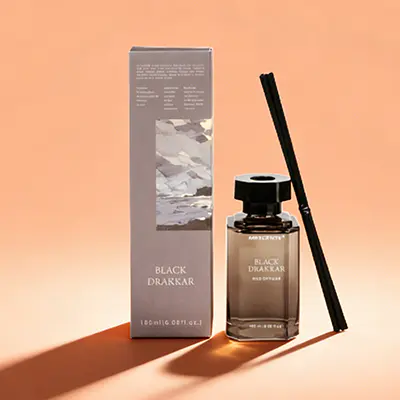
| Reed diffuser |
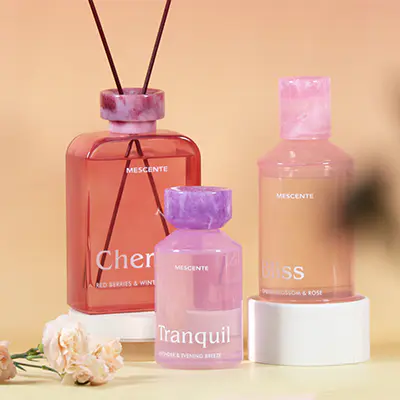
Passive evaporation up porous reeds |
Small rooms, no power needed |
| Ultrasonic essential oil diffuser |
Vibration creates a fine water mist |
Bedrooms, added light humidity |
| Nebulizing diffuser system |
Pressurized air atomizes pure oil |
Stronger scent without water |
| Electric aroma diffuser |
Gentle heat or fan-based dispersal |
Consistent, low-maintenance use |
| Passive fragrance diffuser |
No power, relies on air exposure |
Closets, bathrooms, small spaces |
Types of home fragrance diffusers and differences between them mostly come down to whether they need power and how strong the resulting scent is. A reed diffuser vs ultrasonic diffuser comparison usually favors reeds for simplicity and ultrasonic units for adjustable, on-demand scenting. The best diffuser type for home use often depends less on scent strength and more on how much upkeep a household wants to commit to.
Where Are Home Fragrance Diffusers Commonly Used?
Living room scenting
Diffusers here run longer and lower, keeping shared spaces welcoming without overwhelming guests.
Bedroom aromatherapy use
Lighter, calming scent profiles are common, often paired with quieter ultrasonic units.
Hotel lobby fragrance
Larger nebulizing or HVAC-linked systems maintain a consistent scent across bigger open spaces.
Office ambient scenting
Subtle, low-intensity diffusion avoids disturbing shared workspaces.
Spa and wellness use
Diffusion is paired closely with the room's overall relaxation-focused atmosphere.
A home fragrance diffuser for bedroom relaxation typically runs at a lower intensity than one used in an open living space. How hotels use scent diffusers in lobbies often involves larger-capacity systems built for continuous operation across bigger square footage. Aromatherapy diffuser use in office environments tends to favor the mildest settings available, since shared spaces have widely varying scent preferences.
What Performance Properties Should a Home Fragrance Diffuser Provide?
Scent diffusion consistency matters more than peak intensity — a diffuser that fades unevenly over its first few hours feels far less reliable than one that holds a steady presence.
Fragrance longevity control lets a household decide how long a single fill or reed set should last before needing replacement. Quiet operation matters most for bedroom or office diffusers, where a humming motor can be more noticeable than the scent itself. Adjustable mist output on ultrasonic and electric units allows intensity to be dialed up for larger rooms or down for smaller, enclosed spaces.
How long home fragrance diffusers last depends heavily on reservoir size, oil concentration, and how often the unit runs. What makes a good aroma diffuser for home use usually combines dependable output with an energy efficient aroma device that does not need constant attention. How to control scent strength in diffusers is typically a matter of adjusting run time, oil ratio, or built-in intensity settings rather than the diffuser type itself.
What Fragrance Materials Are Used in Home Diffusers?
- 1
Essential oils blend — plant-derived oils combined for a layered, natural scent profile.
- 2
Fragrance oil formulation — synthesized scent oils designed for stronger, more consistent output.
- 3
Alcohol based aroma solution — common in reed diffusers, helping scent travel up the reeds efficiently.
- 4
Natural plant extract scent — sourced directly from botanicals rather than synthesized compounds.
- 5
Synthetic perfume compound — engineered for consistency and often lower cost than natural extracts.
What oils can be used in home diffusers depends on the device type — ultrasonic units typically call for water-dispersible oils, while nebulizers can run pure, undiluted oil directly. The difference between essential oil and fragrance oil comes down to origin: one is plant-derived, the other formulated in a lab for a specific scent profile. The best scent oils for home fragrance diffusers are usually the ones matched correctly to the diffuser's mechanism rather than any single universally superior option.
How Do Different Diffuser Types Compare With Each Other?
| Comparison |
Typical Outcome |
| Reed vs electric diffuser |
Reeds are passive and low-maintenance; electric units offer adjustable output |
| Ultrasonic vs nebulizing diffuser |
Ultrasonic adds light mist; nebulizing delivers stronger, undiluted scent |
| Passive vs active scent diffusion |
Passive is quieter and simpler; active offers more control over intensity |
| Water based vs oil based diffuser |
Water-based units dilute scent; oil-based units concentrate it |
| Scent coverage comparison |
Coverage scales with device power and room airflow, not device size alone |
Which diffuser is best for large rooms usually comes down to output strength — nebulizing and higher-capacity electric units tend to cover more square footage than a small reed diffuser. In an ultrasonic vs reed diffuser comparison for longevity, reeds often last longer per fill since they release scent more slowly. Differences between home fragrance diffuser types ultimately matter most when matched to the specific room size and desired scent intensity.
What Are the Limitations of Home Fragrance Diffusers?
Limited room coverage is the most common limitation — a diffuser sized for a small bedroom will rarely fill a large open living area at the same intensity. Maintenance and cleaning requirements vary by type, with ultrasonic units generally needing more frequent cleaning than passive reed diffusers.
Fragrance oil consumption adds up over time, particularly with nebulizing systems that use undiluted oil more quickly than water-based alternatives. Device noise issues can be a factor with some electric or ultrasonic units, especially in quiet bedroom settings. Scent sensitivity concerns are worth considering in shared spaces, since not everyone reacts the same way to a given fragrance.
Disadvantages of home fragrance diffusers are rarely severe, but they do explain why diffuser scent may not last long in larger or drafty rooms. Whether fragrance diffusers work in large spaces really depends on matching device output to room volume rather than assuming any diffuser will scale evenly.
What Is the Future Trend of Home Fragrance Diffusers?
- Smart home fragrance systems are increasingly tied into broader connected-home routines.
- App controlled aroma diffusers let users schedule and adjust scent intensity remotely.
- Eco friendly fragrance solutions are shifting toward more sustainable packaging and refill systems.
- Natural essential oil blends continue gaining ground over purely synthetic formulations.
- Personalized scent technology is beginning to let households fine-tune fragrance profiles by room.
The future of smart home fragrance diffusers points toward tighter integration with other connected home devices rather than standalone operation. AI controlled scent diffusion systems remain an early-stage category, but the direction is clear: more responsive, less manual adjustment. Broader trends in home aromatherapy devices suggest continued growth in both natural formulations and app-based control, running in parallel rather than replacing one another.
Frequently Asked Questions
1
What is a home fragrance diffuser?
A device or object that releases scent gradually into a room instead of all at once.
2
Are diffusers better than air fresheners?
They serve different needs — diffusers offer steady, long-lasting scent, while sprays give a quick, temporary burst.
3
How long does diffuser oil last?
It depends on diffuser type and settings, ranging from a few weeks to several months per fill.
4
Can I use any essential oil in a diffuser?
Not always — ultrasonic units usually need water-dispersible oils, while nebulizers can run oils undiluted.
5
Are fragrance diffusers safe for home use?
Most are safe when used as directed, though ventilation and scent sensitivity are worth keeping in mind.
6
How do reed diffusers work?
Porous reeds draw scented liquid upward and release it into the air through passive evaporation.



.jpg "150ml Home Fragrance Reed Diffuser Gift Set With Scented Candle A99189")