

How Quality Materials Improve the Performance of Scent Reed Diffusers
Content
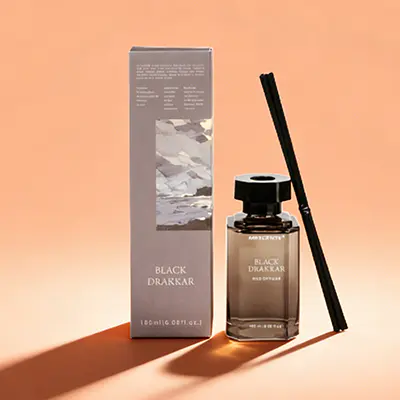
Fragrance oil gets most of the credit, but the real performance of a scent reed diffuser comes from how well its materials work together. The reeds, the base solution, and the container each shape how evenly fragrance travels into a room and how long that fragrance lasts before the bottle needs replacing. A diffuser built from mismatched or low-grade materials can hold excellent fragrance oil and still deliver a weak, uneven, short-lived scent experience, which is why manufacturers who focus only on the oil formula often see disappointing results once the product reaches a customer's home.
What's Inside a Scent Reed Diffuser
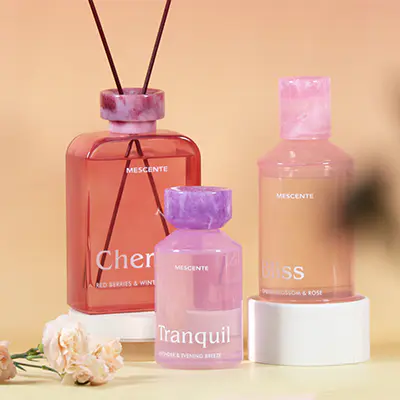
Three material groups do almost all of the work: the reeds that carry fragrance upward, the oil and base solution that determine what gets carried, and the container that holds everything in place without reacting or leaking. Weakness in any single group limits the whole system, even if the other two components are top quality, which is why manufacturers evaluate them together rather than optimizing fragrance oil in isolation.
Reed Sticks
Natural rattan with consistent porous structure absorbs and transports fragrance oil evenly toward the air.
Fragrance Oil & Base
A stable oil and compatible base solution control evaporation rate and how long the scent stays balanced.
Container
Glass resists chemical reactions with fragrance oils far better than plastic, protecting scent quality over time.
Average weeks of noticeable fragrance across three material quality tiers
How Reed Quality Affects Fragrance Diffusion
The reeds do the physical work of moving fragrance oil from the bottle into the air. Natural rattan reeds with uniform, consistent pores draw oil upward efficiently and release it steadily, producing balanced scent intensity across the room. Reeds with an uneven or overly dense structure absorb oil poorly, which shows up as weak fragrance near the bottle and almost nothing a few feet away, regardless of how strong the oil itself was formulated to be. This matters most in hospitality and retail settings, where a diffuser is expected to fill a much larger area than a single home room.
Scent consistency scores across plastic, standard glass, and premium glass containers
Why Fragrance Oil and Base Materials Matter
The base solution determines how easily oil molecules travel up through the reeds and into the air, so a mismatch between oil and base shows up as either overly fast evaporation or a diffuser that barely releases any scent at all. Quality fragrance oils also resist the ingredient breakdown that causes a pleasant scent to turn flat or slightly sour after a few weeks, which matters most in hotel and retail settings where a consistent atmosphere is part of the brand experience.
Modeled fragrance intensity decay, premium versus basic diffuser materials
A well-matched reed diffuser system is one where reed porosity, base viscosity, and container material all support the same evaporation rate, so fragrance intensity stays close to constant for weeks instead of spiking early and fading within days.
Common Material Problems and Their Fixes
Most underperforming reed diffusers trace back to one of three material shortcuts taken somewhere in production, and each one has a straightforward fix once it has been correctly identified.
The Problem
- Weak, uneven fragrance from poorly structured reeds
- Scent fades within days instead of weeks
- Leaking, deteriorating, or discolored containers
The Fix
- Use natural rattan reeds with consistent, uniform pores
- Pair stable fragrance oil with a compatible base solution
- Choose glass containers with strong chemical resistance
Premium versus basic materials across four performance dimensions
Frequently Asked Questions
What type of reeds work best in a fragrance diffuser?
Natural rattan reeds with a consistent, uniform porous structure absorb and release fragrance oil most evenly, giving steadier scent output than reeds with irregular internal channels.
Why does a diffuser lose its scent faster than expected?
Fast fragrance loss is usually caused by a mismatch between the oil and base solution, low-quality reed material, or a container that reacts with or fails to seal the fragrance properly.
Is glass really better than plastic for reed diffuser bottles?
Yes. Glass resists chemical reactions with fragrance oil far better than plastic, which helps preserve scent quality and prevents leakage over the diffuser's full lifespan.
How do material choices affect commercial or hotel use?
Hospitality and retail spaces need long-lasting, consistent output across a larger area than a typical home room, so a well-built scent reed diffuser using quality reeds, stable oil, and a resistant container matters even more than it does for casual home use, since guests and customers notice inconsistency far more quickly than a single household would.
.jpg) |
.jpg) |